
VR & Trompe L'oeil
Introduction
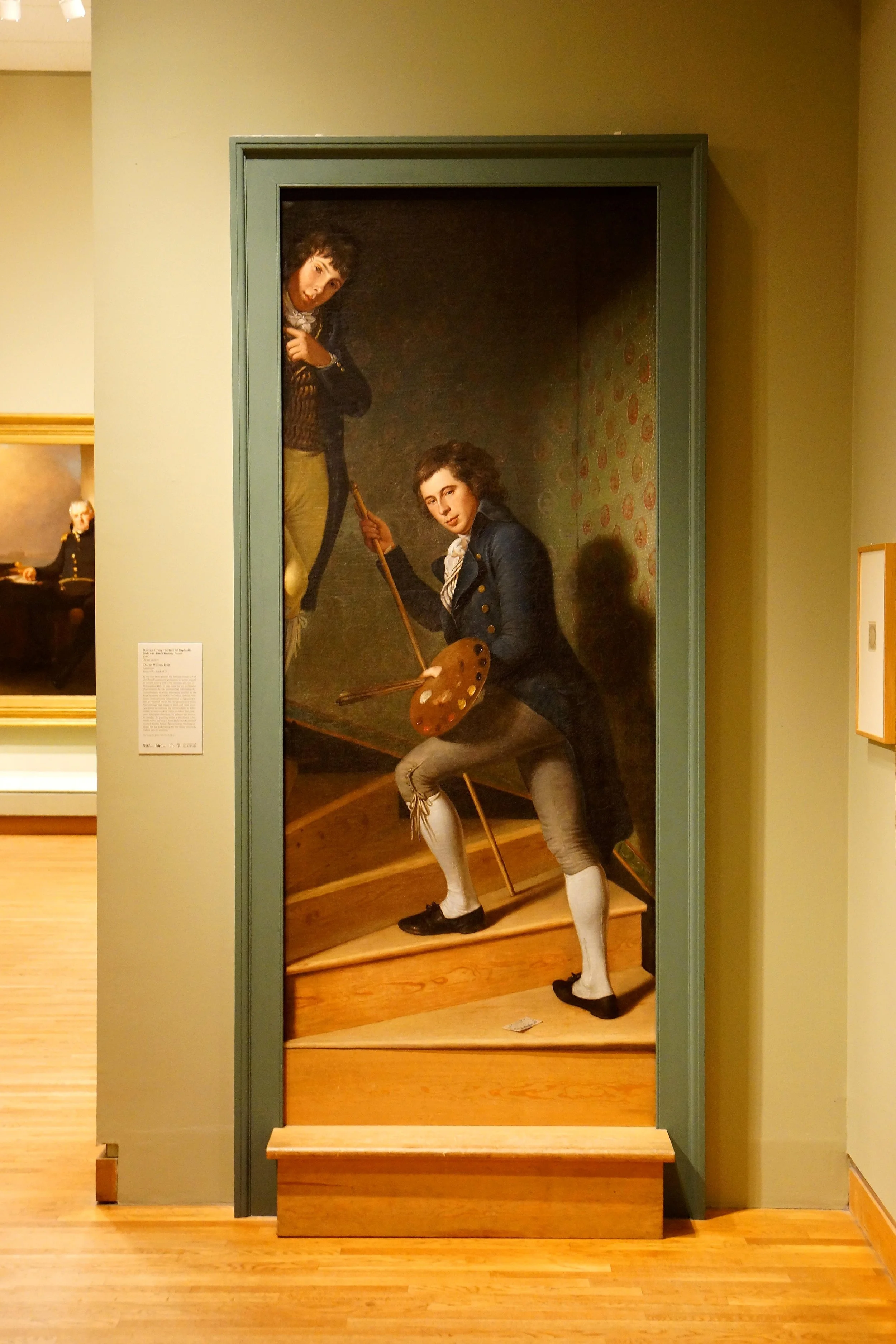
Charles Willson Peale American 1741 – 1827
Staircase Group (Portrait of Raphaelle Peale and Titian Ramsay Peale), 1795
Oil on canvas
Source: Flickr
Trompe l’oeil (French: “trick of the eye”) is the technique of painting objects with extreme verisimilitude to create an illusion of depth. From early ancient Greek architecture to Renaissance paintings, artists have used this technique to fool their audiences into believing they have stepped inside the frame. It is said that trompe l'oeil was introduced by the Greek artist Zeuxis (5th century B.C.) who painted grapes so convincingly that even birds were deceived. What if this age-old trick is no longer an illusion but can be made possible through Virtual Reality (VR)?
VR can help artists make Trompe l’oeil a reality.
The aim of trompe-l'oeil artists and VR experiences is to create the illusion of vast space and distance to an otherwise flat canvas or screen. This is demonstrated through a series of technical skills that blend the painted or virtual world with reality so naturally, that one hardly notices the trick. The end result is an experience that includes elements of fantasy, magic, and surprise. VR can help push the experience even further by bringing the audience into the three-dimensional environment instead of looking at the two-dimensional painting from the outside.
This experience of switching from 2D to 3D in VR is achieved by the concept of immersion- how well technology can blend the way we sense and perceive the world with our everyday life [2]. VR works splendidly because it relies on the same senses we use to interpret reality. For instance, we rely on sight, hearing, taste, touch, and smell to connect with the world. Our brain then interprets these sensations through perception to understand what is happening in our environment. In Virtual Reality (VR), the user wears a headset with mounted goggles, positional audio, and touch controllers that helps heighten our sensations in the artificial environment to create a fully immersive experience of stepping inside the frame.
How are Trompe l’oeil artists and VR able to fool their audiences?
Trompe l'oeil artists: Mastery of geometry, perspective, realism, texture, and lighting to create the illusion of depth
VR: Stereotypic vision & head tracking
-
i.e. ancient Greeks used geometry to carve slightly convex temple columns to correct the distortion of perspective from the ground
i.e. ancient Romans were inspired by marble-like columns of theatrical architecture and used perspective to give great a sense of flatness to their frescoes in Pompeii
-
i.e. Jan van eyck - betrothal of the arnolfini paints in versimilitute- complete accuracy of the richness and detail of each object to give off the appearance of being true.
-
i.e. Jan van eyck switched from tempera (ground pigments mixed with egg) to h. igh-quality oil as he realized it was a much more flexible medium to give off a soft luminosity and transulcent effect
-
17th century italian painters Caravvaggio would often black the background and illuminate the foreground subjects with a single light source to create contrasts between deep shadows and warm highlights
-
Stereopsis is when our brain merges the two slightly different angles from our left and right eyes into a single image. Stereopsis vision allows us to understand how near or far away objects are in relation to one another to create the three-dimensional effect.
-
Head tracking ensures that no matter which direction one looks, the artificial world will move with them. This is done by merging different vantage points into a single environment to give users the flexibility to look up and down, left and right, front and behind naturally much like the real world.
VR is able to extend the artists' tool by offering multiple perspectives into a single environment. Trompe l’oeil is no longer a "trick of the eye" but becomes a "trick of the brain" as VR is able to play with other sensations including hearing and touch to create an even more convincing immersive experience. Let's look at a few current examples of VR & Trompe l’oeil in museums to understand how this affects audience engagement when we switch from experiencing a painting from 2D to 3D.